
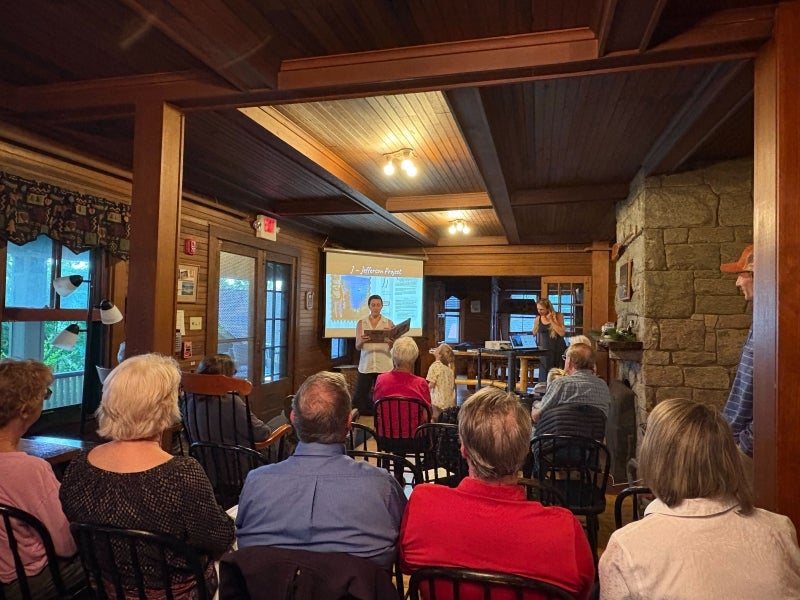
Rensselaer’s Darrin Freshwater Institute and the Historical Society of Bolton are pleased to co-host a series of distinguished presentations on the natural and cultural history of Lake George and the Adirondacks.
Funding for this series is provided by generous gifts from the Knapp Fund. For more information or to inquire about presenting, visit our Contact page or phone (518) 644-3541.
At this time, our lecture series is in-person only, but some archived video recordings of lecture presentations can be found here: DFWI SLS Archives. For information on past lecture topics and presenters, please use the links below.
If you would like to be informed on upcoming lectures, please use the link on the right to sign up for our email list!
2026 Summer Lecture Series Schedule: All lectures begin at 7pm.
June 29th: Jasmine Antonucci, Outreach Intern for Darrin Freshwater Institute
“Observation as a Practice: Nature, Citizen Science, and the Art of Noticing” - Jasmine, a scientist, author, and Illustrator of “Friends with the Ocean” will speak on the Intersection of art, marine and freshwater science, and citizen science through the practice of field notes, sketchbooks, and community observation. Slowing down to notice through drawing, writing, and shared documentation can become a powerful form of environmental awareness and collective action. Blending science communication with illustration and lived experience, this session talk shows how field notes, drawings and images are more than records; they are tools for connection, memory, and resistance against ecological forgetting. From rivers to coastlines, it highlights how communities become active participants in documenting environmental change and shaping how we understand it. At its core, this talk is about attention: how we learn to notice, how we share what we see, and why that act matters more than ever in a rapidly changing world.
July 6th: Jon Borrelli, Research Associate at Darrin Freshwater Institute
“Is Lake George over-salted? Inputs and Impacts of Salt in the Watershed” - We will talk about how freshwater gets salty, how we measure it, where salt is coming from, how it has changed over time, and the effects of salt on the lake. Jon is a Research Associate whose research focuses on developing methods to better understand the ecology of lake ecosystems and using that knowledge to predict how lakes will respond to environmental change. Jon received his PhD in Ecology and Evolution from Stony Brook University studying the relationship between food web structure and the stability of community dynamics. He leverages his expertise in R programming and data analysis to combine insights from surveys, sensors, and hydrodynamic models for modelling and forecasting lake food web dynamics. Jon is developing models to forecast water quality and to identify conditions for potential harmful algal blooms. Working with both internal and external collaborators, he is combining his modelling approaches with long-term predictive models to better understand how different climate change and management scenarios will impact lake water quality.
July 13th: Linden Pearsall, Cornell Cooperative Extension
“Your Home, Their Habitat: Keys to Successful Pollinator Gardens” - As pollinator numbers decline, it's time to bring conservation efforts to our own backyards. Learn how to see your garden through the lens of a pollinator, how to attract them to your landscape, and understand our ADK pollinating insects. Linden Pearsall is the Community Horticulture Coordinator for Cornell Cooperative Extension in Warren County. After working with the National Park Service in the National Heritage Areas program, Linden moved to Colorado to work as a project coordinator at a water heritage-based nonprofit. She would continue working as a nature educator in a local town's Parks, Recreation, and Culture department, where she focused on educating youth about the importance of native plants and pollinators. Linden's current work in upstate New York focuses on coordinating the Master Gardener Volunteer Program and bringing horticulture-based projects and programs to the Warren County Community.
July 20th: Ted Caldwell, Town of Bolton Historian
“The Civilian Conservation Corps in Bolton Landing” - Edgar M. (Ted) Caldwell is a retired builder and educator and is currently the Town of Bolton Historian. He has a BA in Economics from The College of Wooster and an MS Ed. in Administration and Supervision from the State University of New York.
July 27th: Erin Tobin, Executive Director of Adirondack Architectural Heritage
“The Art of Adirondack Architecture” - Erin Tobin joined Adirondack Architectural Heritage (AARCH) as Executive Director in 2021. At AARCH, Erin advances the organization’s strategic goals as AARCH’s chief operating and finance officer. Erin serves as the primary contact for advocacy and special projects, while overseeing the organization’s robust preservation services and educational programs. Prior to AARCH, Erin served as the Preservation League’s Vice President for Policy and Preservation, where she worked from 2007 to 2021. She is Treasurer of the Erie Canalway Heritage Fund board and on the Friends of Parrott Hall board. Erin is a Commissioner on the City of Albany Historic Resources Commission and Instructor for SUNY Westchester’s Historic Preservation Certificate program.
August 3rd: Noah Chirnomas, Author
“The Islands of Lake George: Exploring the History and Mysteries” -
The Islands of Lake George, a new book by author Noah Chirnomas, reveals the rich history of the 125 named islands on the lake. He spent three years poring through archives at museums and libraries, as well as the private collections of locals, in an effort to piece together the long-forgotten history of the lake’s beautiful islands. During this slideshow presentation filled with photographs, newspaper clippings, and artwork, Noah will share the stories of how he uncovered his most interesting historical finds.
He’ll discuss topics including:
- Who did King George III deed an island to?
- Which island did Georgia O’Keeffe include in a painting?
- On which island did a Nobel Prize winner live?
- How did a relaxing day trip to an island lead to a massacre during the American Revolution?
Noah spends time on Lake George every year and enjoys kayaking and camping, exploring the
lake, and learning about its history. He is also the author of Dome Island: Forever Wild on Lake
George. Book signing will follow with copies of his books available for sale.
August 10th: Andrew Gascho Landis and Abbie Gascho Landis, SUNY Cobleskill
“Freshwater mussel life history and conservation in New York” - Freshwater mussels are among the most imperiled groups of animals in North America. They play important ecological roles in our lakes and rivers; however, their unique life cycles can be disrupted when humans alter hydrology and water quality. At SUNY Cobleskill, we have been studying freshwater mussel life cycles and conducting field studies to determine factors threatening their populations throughout the state. Finally, we are exploring propagation as a conservation strategy to restore populations in decline.
August 17th: Jeremy Farrell, Sr. Lecturer of Biological Science at RPI
“What is driving the nearshore algal populations in Lake George?” - Over the last several decades, public observations and concerns have grown over a perceived increase in benthic algae along the nearshore. In response, and with LGPC support, we developed the ALGAE (Assessing Lake George Algal Ecology) project to ask a simple question: what controls where different algal communities grow? Over the past year we visited 100 sites around the lake across three seasons, measuring the algae, water chemistry, lake bottom, and the wind and weather each site experiences. From this we identified five distinct algal communities and the conditions that favor each one. The result is a data-driven framework that helps Lake George managers anticipate where nearshore algae are most likely to shift, and a transferable template that other lakes facing similar concerns can adapt to use on their own shorelines.